
NFS
(A Failure of Collaboration)

I started working with Bungee Space after another venue bailed on me. I reached out to friends for a pulse on NYC shops that might host a JRAT pop-up, and Dianne suggested I contact Bungee. Thankfully, they responded positively to my cold call, and graciously took me on with only a month’s notice. I’ve enjoyed working with them ever since.

Planning for NYFW in February of 2026, I emailed Shisi about possibly collaborating, and together we devised a concept. The collection would be 7 monochromatic JRAT garments, available exclusively through the shop. They would house samples and facilitate orders for limited editions of each piece. Maximalist all around, the 7 garments would be designed to be worn all at once, and each would be made from a classic, materially dense JRAT methodology.
We had a plan and I had a deadline. I began production in late December 2025, but by mid-January, when I needed to wrap up production before shooting, packing, and flying the pieces cross-country: the collection was an ostensible failure.
When I determined all hope was lost, I reached out to Shisi to break the bad news. My offer was to pivot and host a presentation about how the collaboration failed, and thank goodness Shisi loved the idea, because I had nothing else to offer!
A FAILURE OF COLLABORATION
So often collaborations fail, fizzle, or come to nothing. Sometimes they blow up or burn out. It’s not uncommon, even in my own history. I worked collaboratively for 7 years on a project with a close friend, only to have it crash out in 2020. I had invested all of my creative labor into the collaboration and lost my singular voice. In their absence, I was faced with a creative crisis; what could I salvage from the collaboration and call my own? Aesthetics, methods, techniques, connections—they were all up for debate. JRAT was born in the midst of sifting those ashes, and I am still sorting what I can repurpose without infringing on the intellectual property of my former collaborator.
The failure of this collaboration was different, however. It wasn’t an issue of interpersonal dysfunction, but a failure of process resulting in a product that I did not feel comfortable producing in multiples. I’ll explain:
NUTS AND BOLTS
No. 1: The Methods
The two main methods utilized within this collaboration were 3T and zero waste pattern drafting. Methodology is central to my practice. Often the outcome of the process doesn’t matter as much as the success of the process itself. In this way, process can dictate aesthetic, and the aesthetic is ultimately a product of process.
Method 1
3T originated in 2022 when I assisted my aunt in purging her extensive clothing collection. We were able to sell her vintage but the generic, modern garments were harder to rehome. Instead of donating them, I decided to warehouse everything at my 300 sqft studio. Knee deep in t-shirts, I needed to solve this growing storage issue. I disassembled 3 shirts, stacked them, sewed through the stacks, cut between sewn lines, then reassembled the components back into a single piece: 3 t-shirts became one. 3T makes use of otherwise hopeless materials, validating their existence, and extending their longevity as wearable items. Wearing more clothing, and wear more at once, is a way to honor the labor of garment workers; ensuring that what they literally slaved to create was not made in vain. 3T has become JRAT’s answer to “basics”. Texturally and experientially dense, these pieces still retain the shape and fit of a traditional garment.
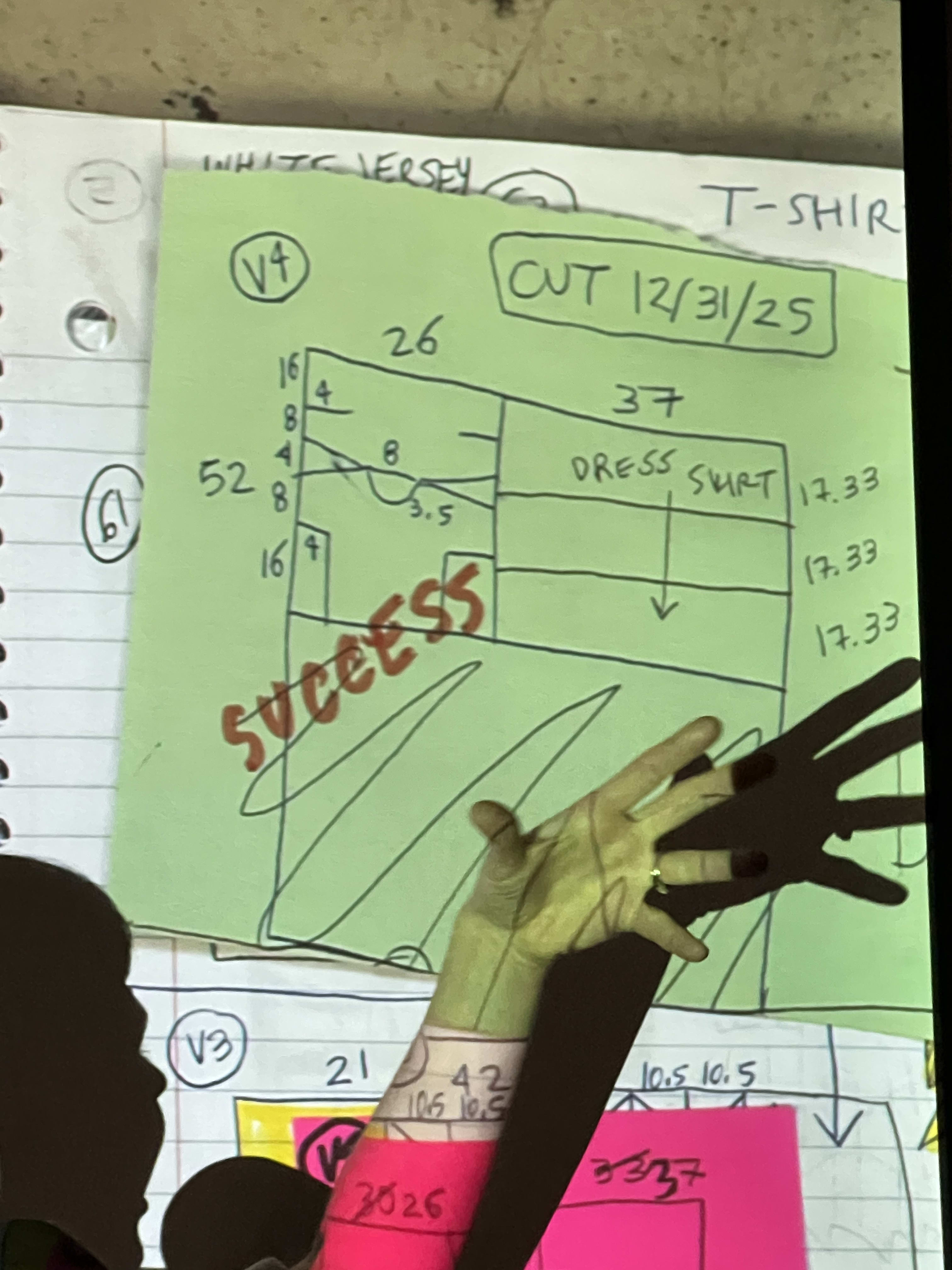
Method 2
Zero waste pattern drafting ensures nothing is wasted when cutting and sewing a garment. Each pattern piece puzzles together, with no gaps, and thus, no waste. Comparatively, traditional manufacturing discards about 15% of textiles: amounting to billions of yards disposed annually.
Normally, I don’t combine these two methods. But this collaboration offered an opportunity to experiment. I drafted zero waste patterns for 7 different garments: (1) a jacket, (2) a t-shirt, (3) pair of paints, (4) a dress, (5) a bag, (6) a belt, and (7) a skirt and turned next to the materials.
No. 2: The Materials
LAYER 1
The base layer of each garment would be cut from deadstock textiles. Deadstock is excess bolts or rolls of fabric from mills, manufacturers, or brands. Sold through rag houses or other secondhand markets, deadstock can result from: intentional overproduction, canceled orders, flaws in the yardage, or an abandoned curtain factory that has been taken over by an art collective and they need to sell the bolts of fabric in the basement in order to pay for a new heading system. (True story.)
In the case of my deadstock, it came from a post in Craiglist’s free section by a local manufacturer who was shifting production away from clothing. We loaded up the back of my grandmas’ CRV with all the bolts it could hold—including a semi-stretch white cotton twill (jean material) and white cotton jersey knit (t-shirt material)—layer 1.
LAYER 2
My parents manufactured clothing in Seattle for over 20 years. Around the time their business closed, another garment manufacturer opened; and Prairie Underground is manufacturing in Seattle today. I am grateful to have them as a friend and longtime supporter. We’ve collaborated in 2023, AUGHTY GRRRLZ in 2024, they hosted my 14 Hours performance, and we have another collaboration in the works ;)
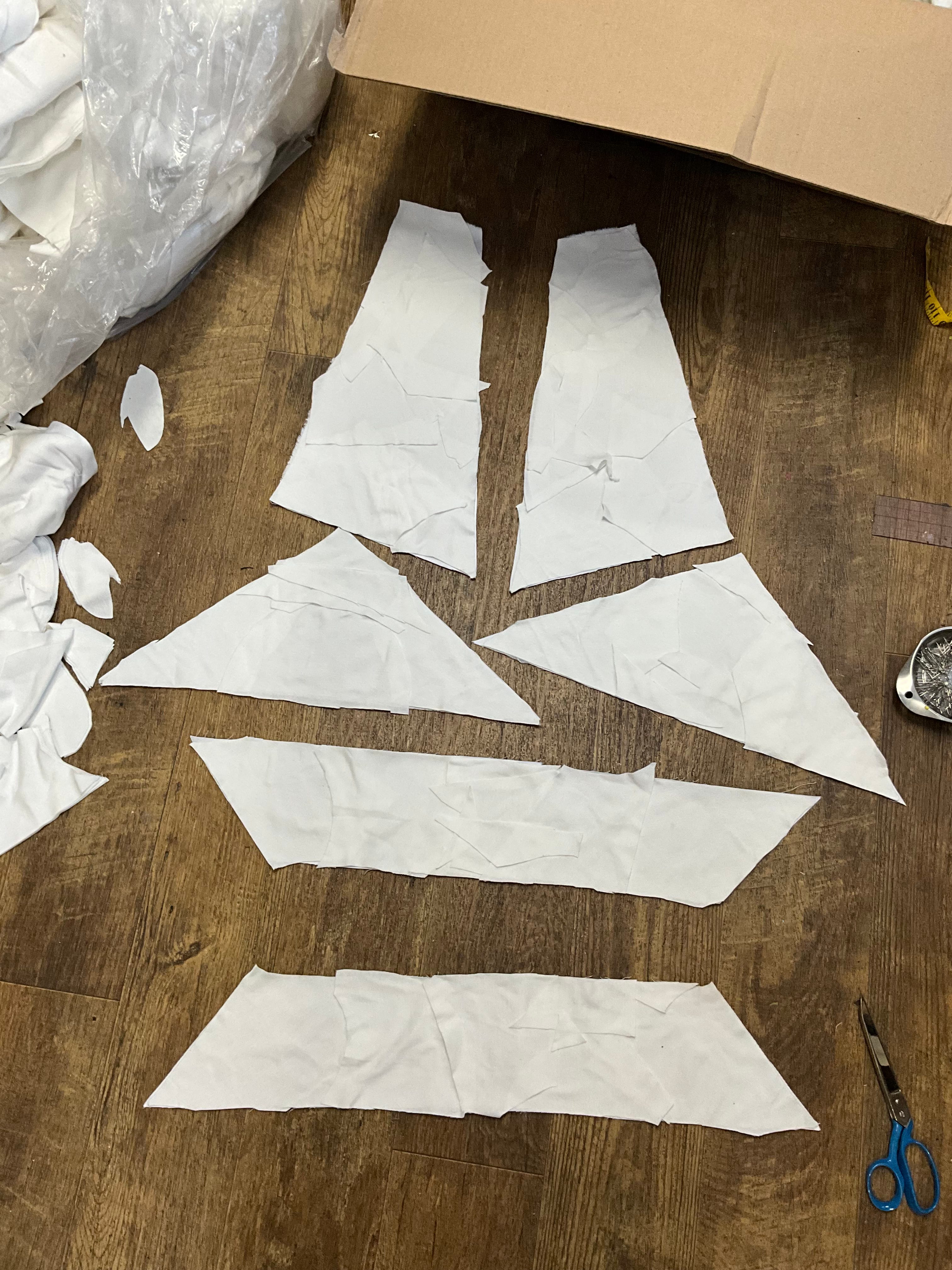
Prairie Underground mainly works with undyed organic cotton. Salvaged off cuts from their production served as layer 2 in this textile sandwich. Each piece of cotton scrap was collaged by hand onto the pattern pieces cut from deadstock, then followed by layer three.
LAYER 3
In 2020, I bought a 50 pound box of industrial t-shirt scraps *with prints. (*Because it was cheaper.) Often sold as rags to business like auto body shops, I went through each print and cut out all the letters then cut the remaining image into strips and sewed them on to various backings to create the Scrap 10 collection. This collection contributed to the inspiration in designing costumes for the Pacific Northwest Ballet last year, when choreographers Amanda Morgan and Christopher D’Ariano hired me for a new piece they were creating. The costume shop had remnants from previous projects which we used for the costumes, in combination with chunks of t-shirts from 2020. I had asked the costume shop to purchase another box of scrap, but it arrived after the performance had ended, so they gifted it to me.
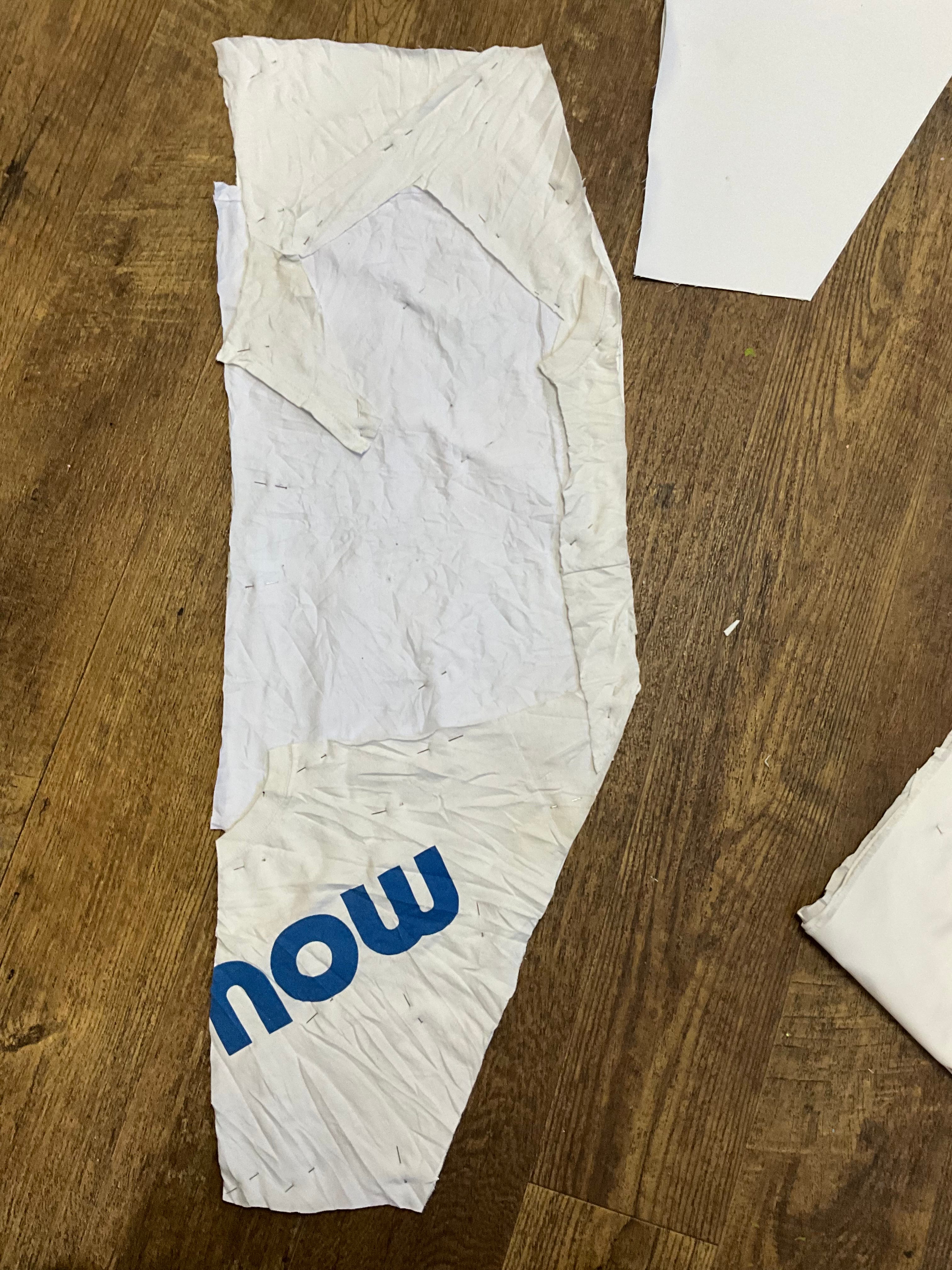
This material became layer 3. I intentionally scattered the random prints, graphics, and words across the top surface of each garment. In order to secure all three layers before sewing, I had to employ a lot of pins to prevent the small bits from slouching and scrunching. I then sewed through all the layers, cut in-between sewn lines on the top two layers, then set out to assemble each garment.
No. 3: The Execution
I don’t do muslins. A muslin is a rough draft of a garment made from a cheap fabric called “muslin”. Refined throughout the drafting process, muslins ensure a precise finished garment. Since my college days, I’ve found muslins to be wasteful—especially if you’re creating one offs as opposed to patterning for mass production. In order to find success in a single garment, I allow the flaws of my pattern to inform the final aesthetic of the piece.
This anti-muslin philosophy marked the beginning of many failures to come.
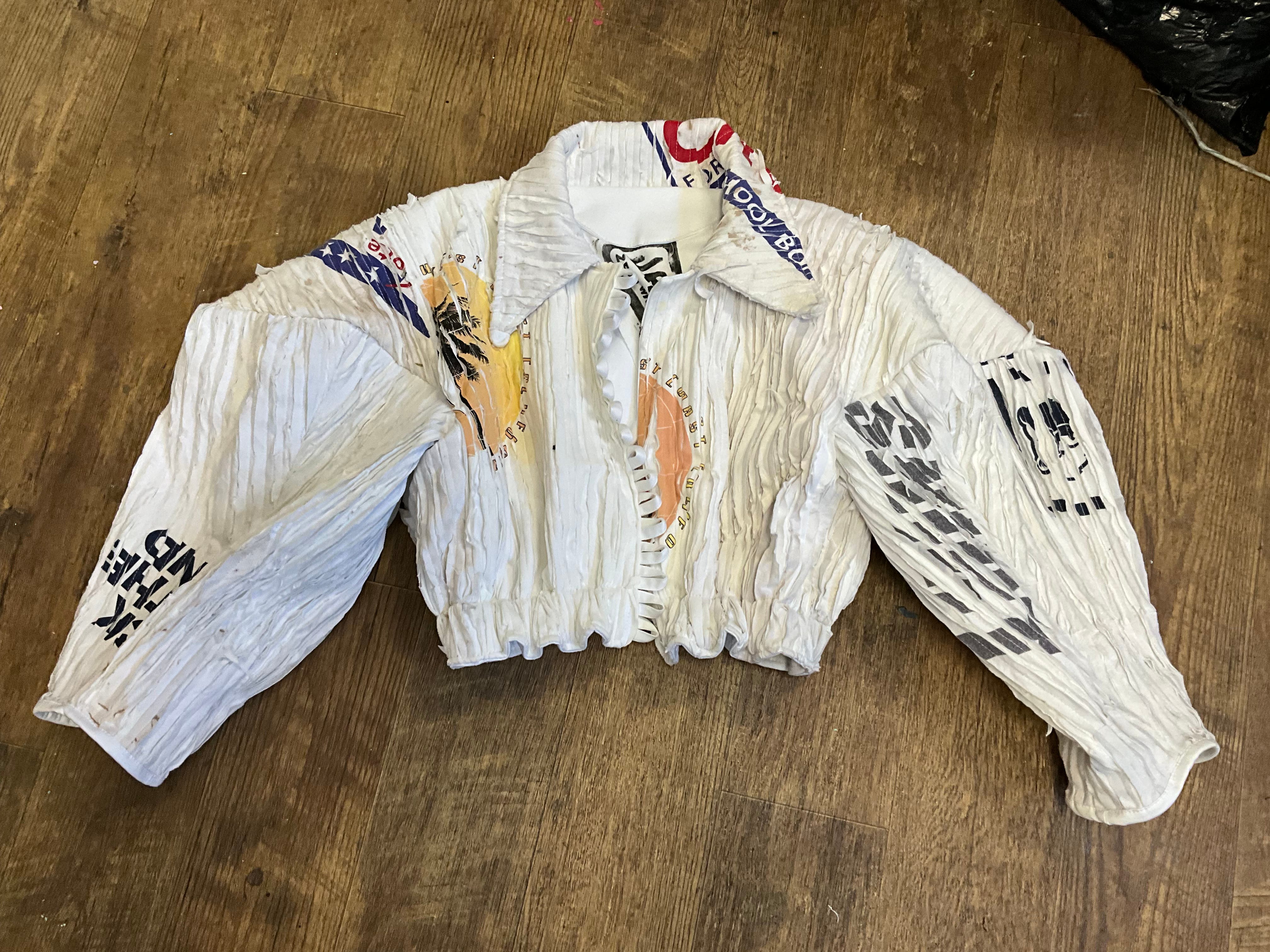
The first garment I cut, sewed, and finished, was the jacket. And she turned out cute. Bulky, but cute. This gave me hope for the rest of the pieces.
Next I made a t-shirt which was also deceptively successful. The sleeves felt clunky, so I folded them up and tacking them down. This meant the interior of the sleeve was now textured. Though not an issue per se, to me, it indicated a fixed flaw more than a design detail. The neckline grew more than expected because the deadstock jersey knits excessive give.
After two mild successes, the pant pattern proved problematic. There were two pattern pieces that I couldn’t integrate into the final pant, so these leftovers required a resolution, and thus, more adventures in pattern drafting. The fit of the pants was questionable as well. I set the crotch too high and the wrap element left for some cheeky exposure that might turn off some.
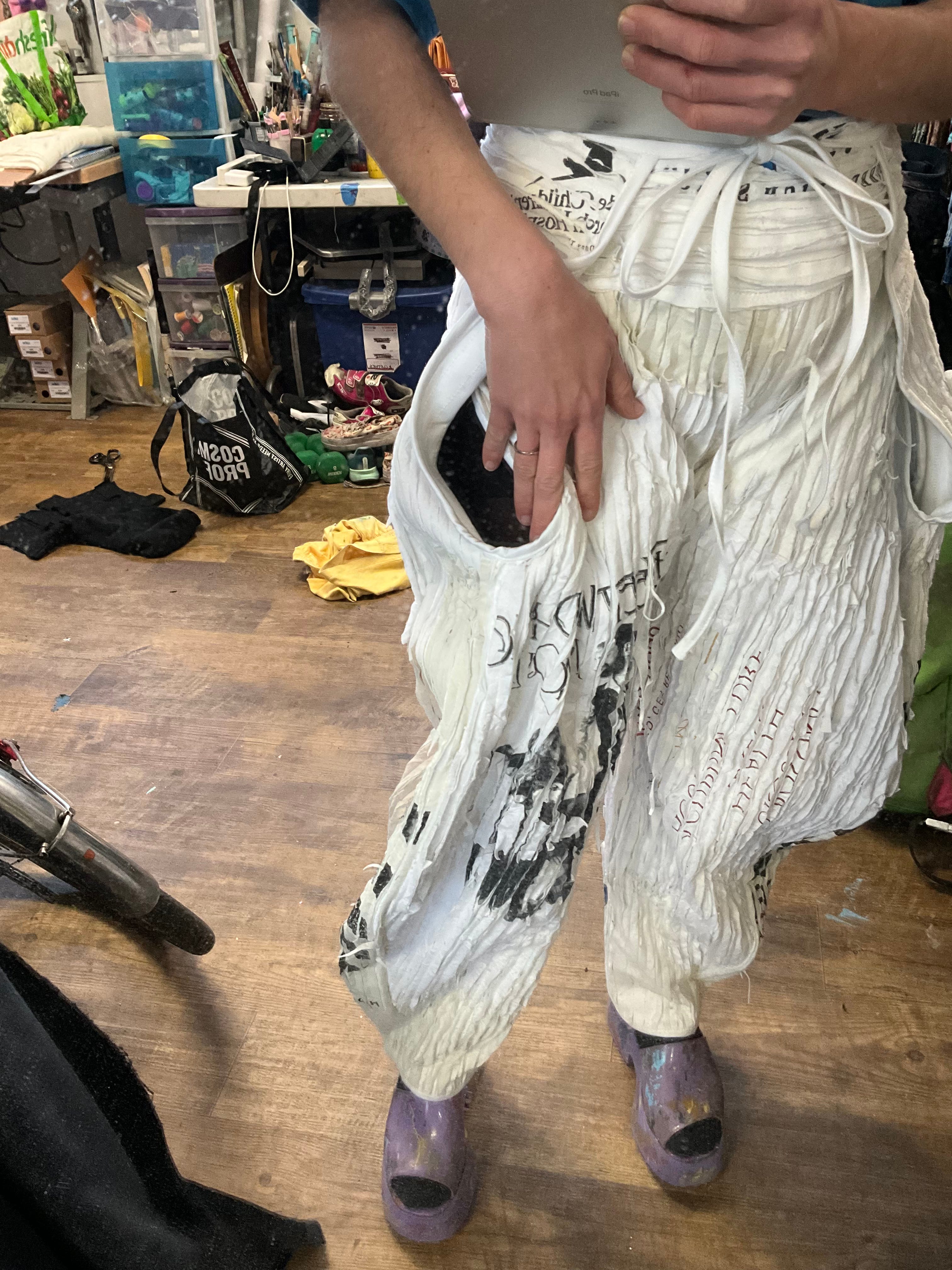
I made an alternative pant pattern, but they flopped too. The drawstring waist was too bulky with 6 layers of fabric to scrunch. (Though the crotch fit better and this pair had pockets!)
The pockets came from a massive failure: the dress. I created a pattern for the top of the dress that integrated the bag and pockets for pant V2. The dress top would be combined with the second half of the t-shirt pattern because it only used 27” of a 63” wide fabric. Zero waste patterning is beholden to the “selvedge” or width of the material. If the fabric is 54” wide, then the marker, or the layout of pattern pieces for cutting, has to be 54” wide. If less, then a partner pattern can utilize the leftover space, which was my plan in this case.
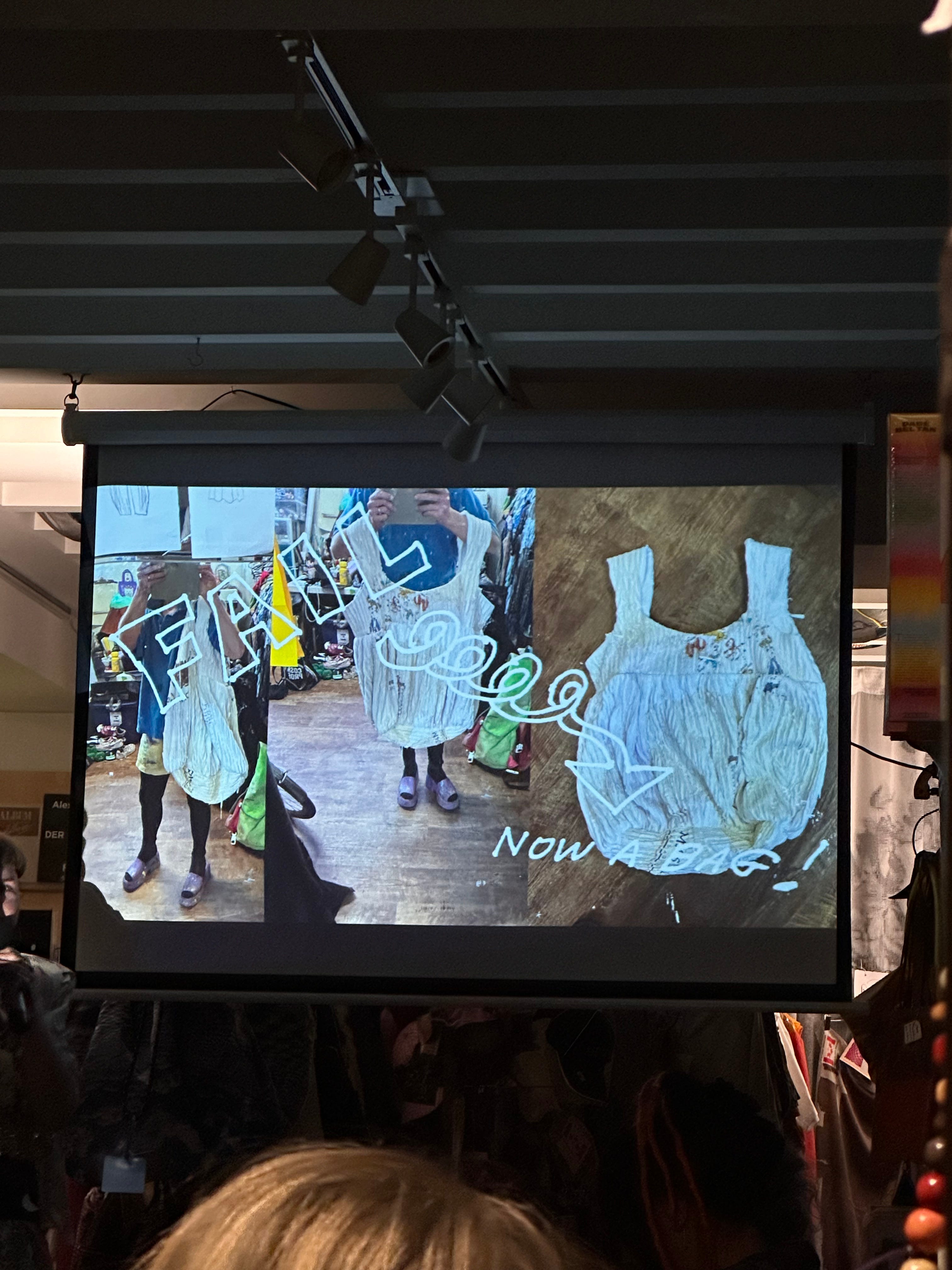
When I connected the top of the dress to the skirt, the seam across the midsection was incredibly bulky. The rigidity of the twill top caused the dress to stick out in uncomfortable ways, instead of draping, especially at the underarm. I decided to pivot and use the remaining bag pieces to form a base for the dress and turn the whole dress into the bag and voila!
The world’s most unnecessary bag. Who needs this bag? (Rhetorical question, do not comment.) This bag doesn’t need to exist.
For me, it was a failure. Pure and simple.
At this point, I was discouraged. And running out of time. I could live with the jacket and t-shirt results, but both pants were a disappointment, and I didn’t have a dress because it became a bag, which I hated, and there were still two triangles from the pant V1 that need a resolution, and what about the plan for the belt and skirt??
I chose to preserve and pivot. I drafted a pattern for a skirt, a ruffle belt (incorporating the pant V1 leftovers), and a new t-shirt with better sleeve and neckline. I cut, layered, and sewed all these pattern pieces. Around the same time, a new intern started. Her school required an internship for graduation and she needed to make up a lot of hours in a hurry. So I sent her home with these 3 garments to cut in-between the sewn lines on the top two layers so that I could sew the pattern pieces together, assemble the garments, and be done with this train wreck. She came in the following week and had cut everything backwards.
She cut the base layer instead of layers 2 and 3.
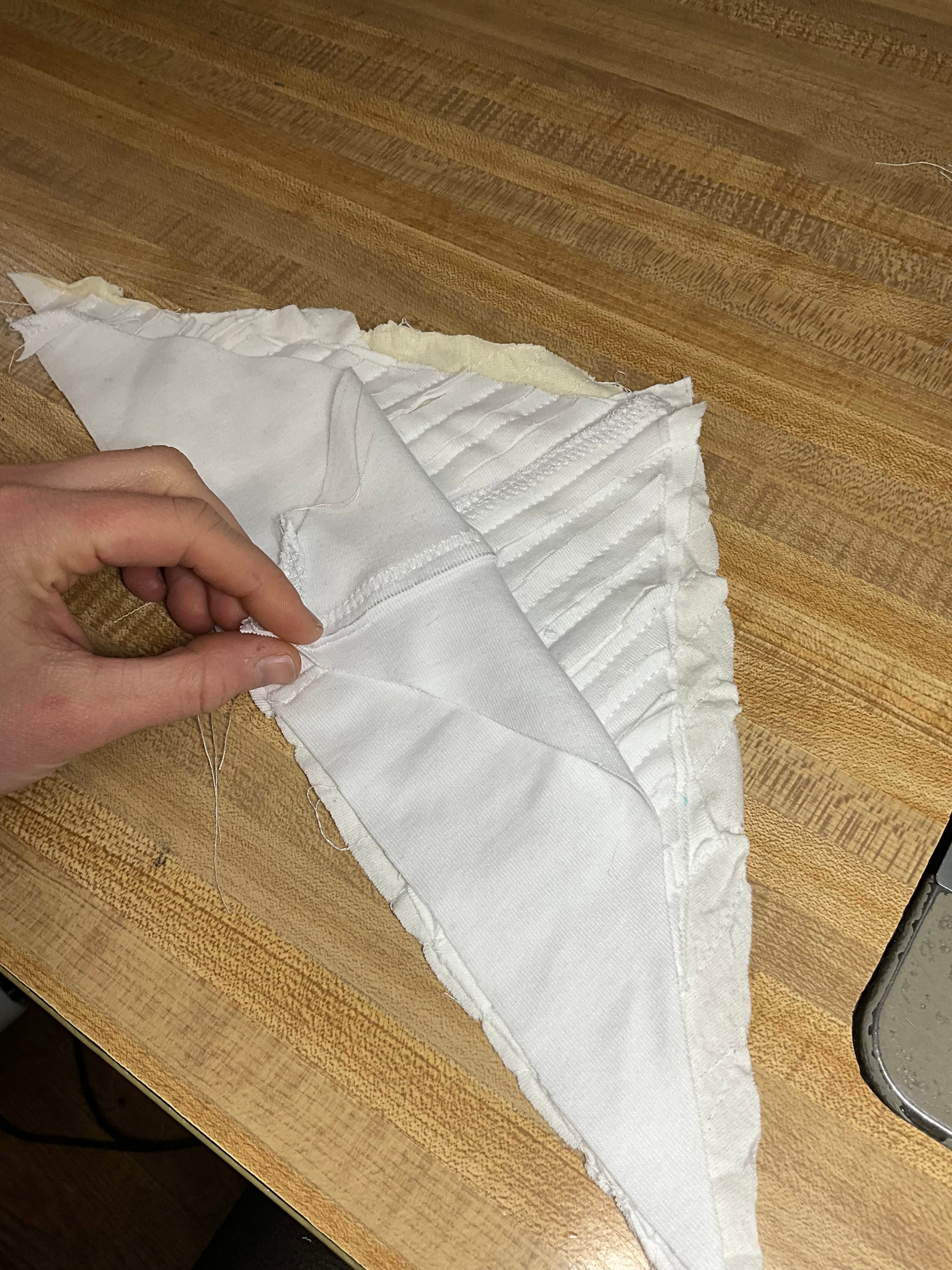
She cried a little in my studio when I showed her the mistake. I’ve been that girl, crying at work. My first gig after college was to design and produce dance costumes for a Seattle based company. Two weeks before the show, I brought the pieces to rehearsal for a fitting and the choreographer eviscerated my designs in front of the entire company. I was effectively fired on the stop and never compensated for my time or materials. I felt for my intern in that moment and was genuine when I said it was ok, and if anything, her mistake was helpful. This project needed a nail in its coffin and this was THAT.
These pattern pieces couldn’t be salvaged. If I cut and sewed on new backing, there would be 4 layers of material instead of 3, making the samples inaccurate to the items customers would ultimately receive; and I didn’t have time to remake these pieces from scratch. That’s when I called Shisi and pivoted once again.
No. 4: The Results
I finished the final failed pieces, giving them 4 layers instead of 3. I made a PowerPoint about how the collection devolved and concluded with bullet points on why I couldn’t make editions of these garments:
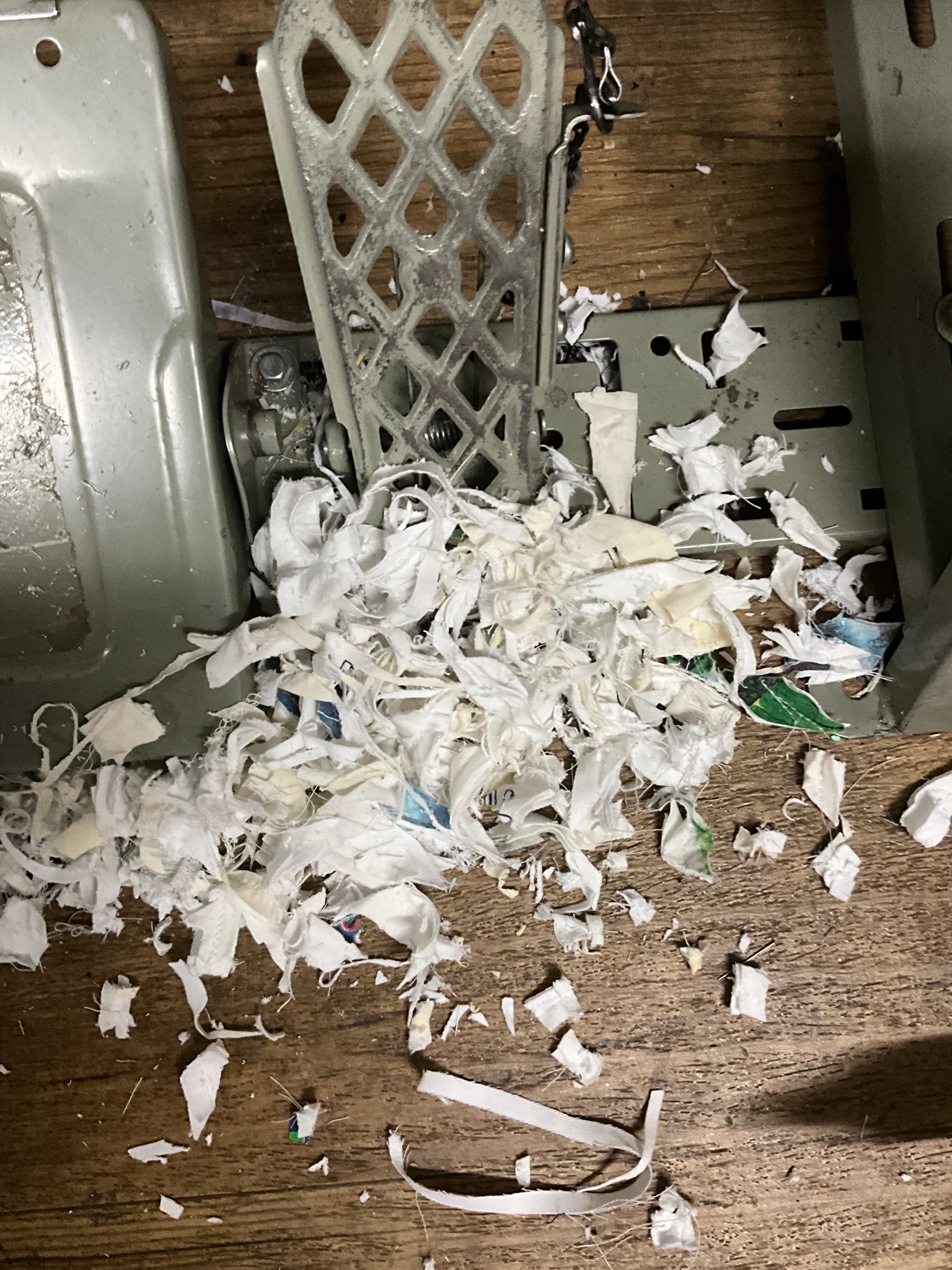
Ultimately, this method was too wasteful. As I sewed the knit fabrics on top of the woven, the knits shifted, pushing past the edges of the woven base, which created a lot of off cuts when serging and finishing. The combination of zero waste patterning and 3T was experimental to begin with, and the experiment failed because of this particular combination of materials.
Each garment was too labor intensive to keep affordable. Between the collaging and pinning of multiple layers of materials, sewing became unmanageable, taking more time, resulting in a higher cost. I price my labor at $50/hour, making wholesale $500-600, retail $1000-1200 per garment. My work is worth that price, but I’m not comfortable selling subpar product at such a high rates.
And finally, with all the patterning mishaps and problems caused by material bulk, the wearability issues could not be surmounted.
CONSOLATION PRIZE
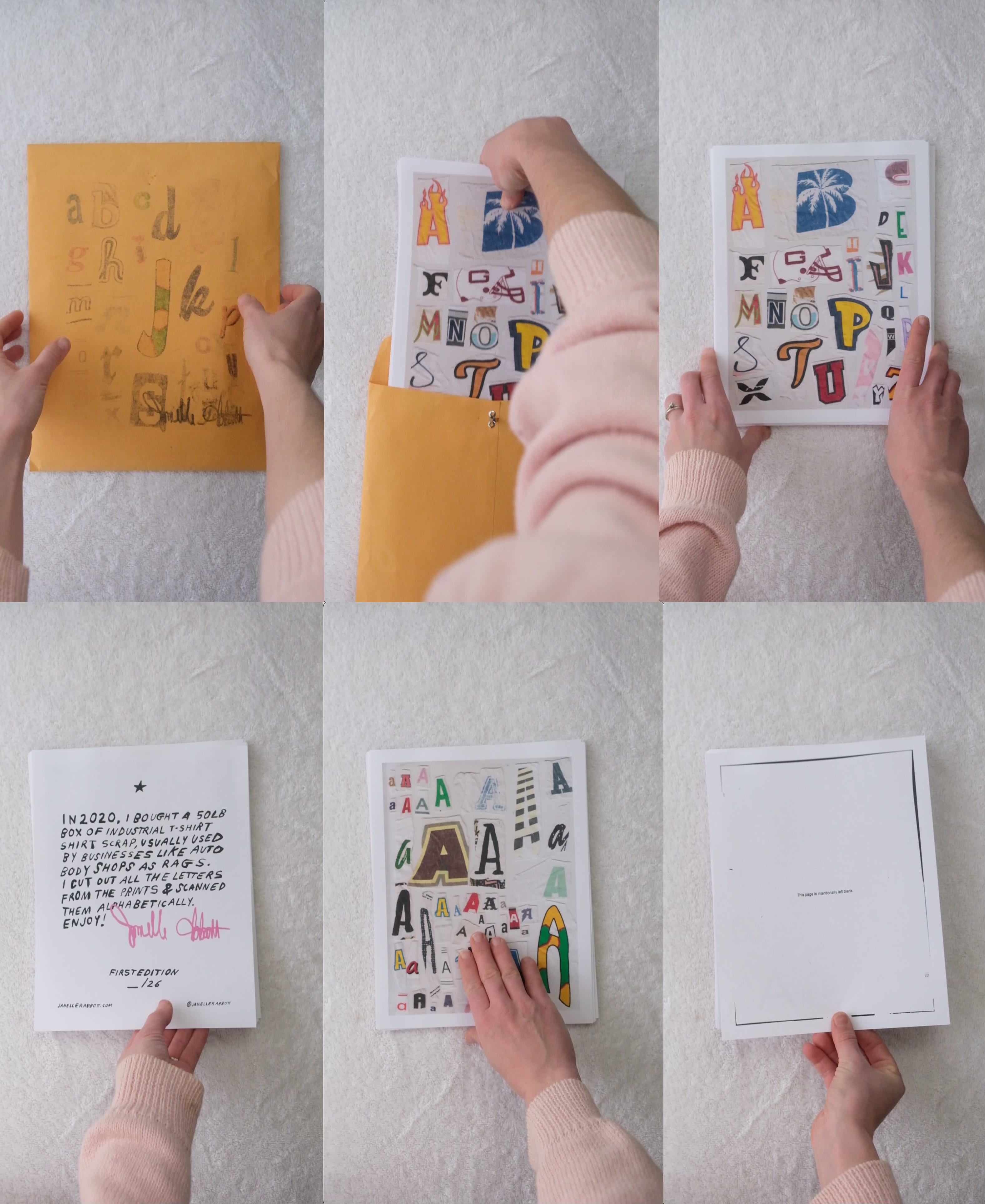
Both Bungee Space and I have to run our businesses. Despite the collections title, NFS (Not For Sale), I still wanted to offer something. My consolation prize was an 83 page zine of scanned t-shirt letters than I created back in 2020. The zine is limited edition, available exclusively through Bungee Space, and I hope you will consider supporting us both by purchasing a copy. The zine is loose leaf so you can frame individual pages, give them away to loved ones, or cut out and collage the letters like a serial killer.
IN CONCLUSION
My friend David wore the NFS look during NYFW and reported back that many commented on how fab his fit was. The aesthetic success of this collection is deceptive. They are a result of a failure of process and thus, not sustainable for replication. David arrived at the end of the presentation to walk Bungee Space like a catwalk, and ever on theme, he was late. It was perfect.
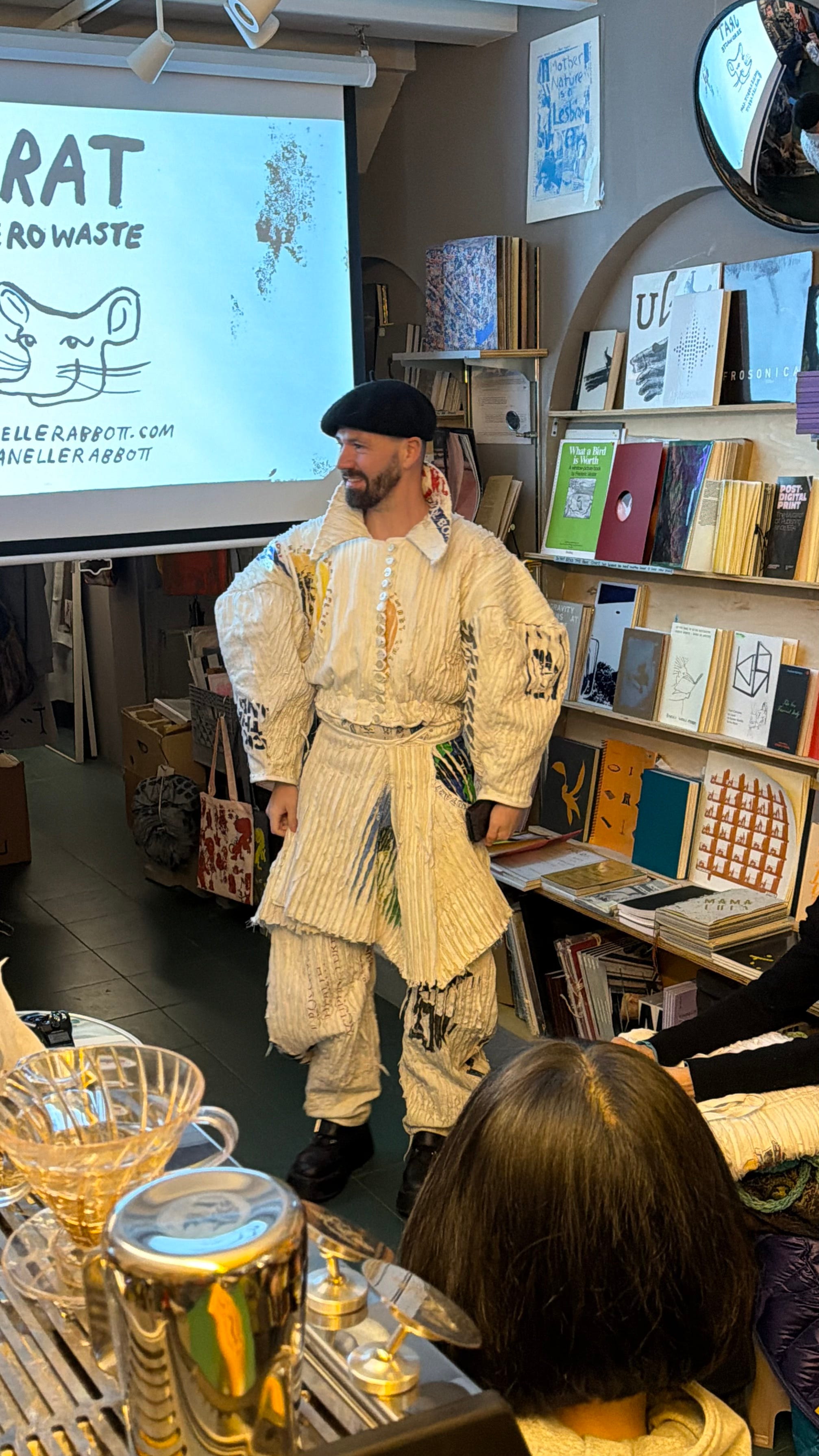
I allowed the audience to vote on the final destiny of these pieces. Either we archive them, sell them, reproduce them, or burn them cathartically in the middle of the street. Two people voted for burn ‘em, and I appreciate that. For now, they are archived in my studio. At a later date, I may explore this concept again—combining zero waste patterning and the 3T method is certainly possible, but this was not the way. The failure of NFS wasn’t a real failure though. I successfully navigated a series of mishaps, many of which by my own design, and made something informative, meaningful, and entertaining in the end. I am most proud that despite it all, I was able to maintain good relationships with people I respect and look forward to working with again and again.
PS— See the full NFS collection here. And here.
PSS— Listen to the February 12th 2026 NFS presentation at Bungee Space here.
PSSS— T-shirt Alphabet Zine available is here!
Thank you for writing about this! I've been experiencing some setbacks in my own practice recently (including in collabs) and it's super encouraging to hear these honest histories. It's really true what you said, that the thing to be the most proud of is maintaining good relationships. When we are kind and understanding and open to others, then it opens the door to be kind and understanding and open to ourselves. ("forgive and you shall be forgiven"--it's not instructions just a fact of life.)
I'm currently looking at a piece that came out of the kiln not how I hoped, and I'm finding some compassion for it (and for myself) knowing that art is hard and working with real materials in an honest way is also hard. And if we, as humans, are going to search for a new path, failure is PART of the path, not a deviation from the path. Failure, mistakes, and surprise means we are successfully exploring new spaces. Do I still feel agonized every time I look at my failed piece? Yes a little bit. Maybe less now because of your post. 🤍